

What is The Best Database for Angel Investors?


Most founders spend weeks combing through LinkedIn and outdated investor lists, only to end up pitching the wrong people or sending cold emails that never get opened.
The result?
Founders burn time, lose momentum, and watch competitors close rounds faster.
That's where investor databases replace guesswork with precision.
The right database filters by industry and geography, surfacing verified investors who actually fund startups.
In this guide, we'll break down what makes a database truly useful, how to compare the top platforms, and how to pick the one that fits your stage and budget in 2026.
How Does an Angel Investor Database Work?
An angel investor database is a search engine for investors.
It works by gathering verified data from public findings, pitch rounds, and direct submissions to build detailed investor profiles with check sizes, industries, stages, and past investments.
Founders can then filter and target the exact type of investors that fit their startup. Instead of manually hunting for leads, you get an organized, up-to-date list of angels who are actively investing.
The 6 Databases Powering Today's Most Funded Startups
1. Angel Match
](/_next/image?url=https%3A%2F%2Fangelmatch-store.sfo3.cdn.digitaloceanspaces.com%2Fblog%2Fmeta%2Fwhat-is-the-best-database-for-angel-investors-image2.png&w=3840&q=75)
Angel Match leads the list for one reason: precision and value.
Instead of scraping random investor names, it curates verified profiles from hundreds of funding announcements, accelerator networks, and investor syndicates. It provides founders with direct access to over 125,000 active angel investors and VCs.
Its filtering system is built for startup founders, not financial analysts. You can sort investors by check size, industry, geography, investment stage, and even portfolio overlap, cutting outreach time from weeks to hours.
Where most tools stop at the list, Angel Match runs the whole raise: a built-in fundraising CRM to track conversations, email outreach to pitch investors directly, plus pitch deck hosting, a data room, and investor updates to manage the round after the first meeting. It's the difference between a database and a fundraising platform.
Why It's Ranked #1:
Angel Match combines the reach of large investor databases with a full fundraising toolkit and offers superb value with basic plans starting at just $59/month.
The platform updates weekly, so investor emails and investment focus details stay up-to-date. For founders raising pre-seed to Series B who want verified contacts and a fast path from search to outreach, it's the strongest fit on this list.
Feature | Details |
|---|---|
Database Size | 125,000+ verified investors |
Filters | Stage, industry, location, investor type |
Best For | Founders raising pre-seed to Series B |
Standout Feature | Full fundraising platform: CRM, outreach, deck hosting, data room |
2. Crunchbase
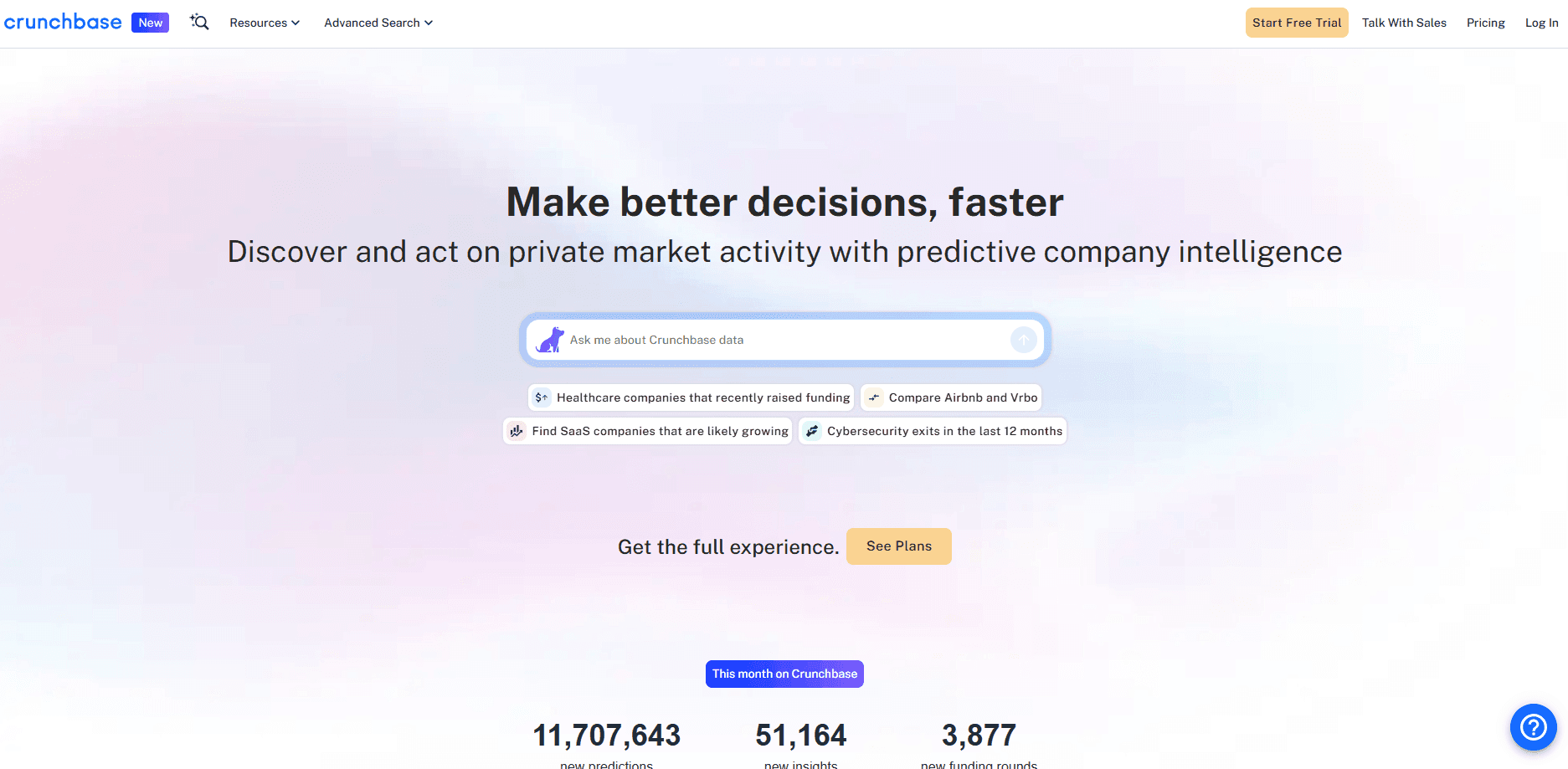
Crunchbase is one of the most common names in the startup community.
With data on 240,000+ investors and firms, it helps founders, sales teams, and analysts discover who's funding what and when.
Its Pro version provides advanced search filters, company funding histories, and deal tracking tools.
Why It's Ranked #2:
Crunchbase offers unmatched coverage at a reasonable price (starting at $29/month), but doesn't provide verified contact details like Angel Match.
It's best suited for founders who want to identify potential investors, then do their own outreach via LinkedIn or email research.
Feature | Details |
|---|---|
Database Size | 240,000+ investors/funds |
Filters | Location, round type, industry |
Best For | Founders and analysts seeking funding insights |
Standout Feature | Massive funding and a company data ecosystem |
3. AngelList
](/_next/image?url=https%3A%2F%2Fangelmatch-store.sfo3.cdn.digitaloceanspaces.com%2Fblog%2Fmeta%2Fwhat-is-the-best-database-for-angel-investors-image4.png&w=3840&q=75)
AngelList remains one of the most recognized platforms for connecting with angel investors and startup talent.
It originally began as a place for founders to list startups and find early backers, but has evolved into a massive deal-flow and talent ecosystem.
Founders can create a profile, tag their startup by industry, and gain visibility among thousands of active investors. For investors, AngelList offers syndicates and funds, allowing angels to co-invest with proven lead investors.
Why It's Ranked #3:
AngelList's strength lies in its network effect; everyone in the startup world uses it.
However, its investor discovery experience isn't as streamlined or data-focused as Angel Match's or Crunchbase's, and it has leaned increasingly toward syndicate and fund management rather than founder-led outreach.
Feature | Details |
|---|---|
Database Size | Millions of members |
Filters | Stage, geography, syndicate access |
Best For | Startups looking for exposure and credibility |
Standout Feature | Access to syndicate-led investment rounds |
4. Angel Investment Network (AIN Global)
](/_next/image?url=https%3A%2F%2Fangelmatch-store.sfo3.cdn.digitaloceanspaces.com%2Fblog%2Fmeta%2Fwhat-is-the-best-database-for-angel-investors-image5.png&w=3840&q=75)
AIN Global operates across 80+ countries, bridging startups and individual investors through regional angel platforms.
It's one of the largest global angel databases, especially useful for founders outside North America or Europe who want to reach international investors.
Founders can post a fundraising listing, and interested angels reach out directly. The network's paid tiers also include investor messaging tools and listing promotions, but the fee depends on the region.
Why It's Ranked #4:
AIN's scale is unmatched globally, but it's less curated than Angel Match. While you'll find quantity here, filtering for relevant or actively investing angels can require extra time and outreach.
Feature | Details |
|---|---|
Database Size | Hundreds of thousands of investors globally |
Filters | Region, sector, investment size |
Best For | Startups seeking global angel visibility |
Standout Feature | Global investor coverage across 80+ networks |
5. SeedBlink
](/_next/image?url=https%3A%2F%2Fangelmatch-store.sfo3.cdn.digitaloceanspaces.com%2Fblog%2Fmeta%2Fwhat-is-the-best-database-for-angel-investors-image6.png&w=3840&q=75)
SeedBlink blends angel investing with equity crowdfunding, primarily focused on European startups.
It enables accredited investors and the public to co-invest in vetted startups while providing founders access to a curated investor community.
The platform combines investor data, due diligence tools, and campaign hosting, making it ideal for startups aiming to build awareness and raise capital simultaneously.
Why It's Ranked #5:
SeedBlink's hybrid model makes it stand out, but it's better suited to European founders.
Feature | Details |
|---|---|
Database Size | 110,000+ verified investors |
Filters | Sector, round type, geography |
Best For | EU startups raising pre-seed to Series B. |
Standout Feature | Crowdfunding + angel syndication model |
6. PitchBook
](/_next/image?url=https%3A%2F%2Fangelmatch-store.sfo3.cdn.digitaloceanspaces.com%2Fblog%2Fmeta%2Fwhat-is-the-best-database-for-angel-investors-image7.png&w=3840&q=75)
PitchBook is the gold standard of investor and market intelligence, used by VCs, PE firms, and banks.
Its platform hosts data on 100,000+ investors within a massive database of over 3 million companies, offering unmatched analytics and funding insights.
Why It's Ranked #6:
PitchBook delivers deep insights but comes with enterprise-level pricing, starting around $20,000/year.
It's ideal for institutional investors, not bootstrapped founders.
Feature | Details |
|---|---|
Database Size | 100,000+ investors |
Filters | Sector, funding type, geography |
Best For | VC firms, analysts, corporate investors |
Standout Feature | Comprehensive deal flow and valuation data |
How to Find the One Database That Fits Your Funding Strategy
Not every investor database will work for every founder.
A common mistake for most founders is thinking the best database is simply the one with the highest number of investor listings.
To find a database that actually fits your funding strategy, work through these five steps:
1. Start With Your Stage
Before anything else, identify where you are in your fundraising journey.
If you're pre-seed or seed, choose databases that focus on active angels and micro-VCs (like Angel Match). For later rounds, look for databases that blend angel investors with institutional funds (like AngelList). A database that's too broad will bury you in irrelevant contacts.
2. Look for Verified and Updated Data
A huge investor list is useless if half the emails bounce.
The best databases update weekly or monthly, validating whether investors are still active, what sectors they're investing in, and how much they typically commit.
Choose accuracy over volume. Verified data always wins.
3. Match by Industry and Geography
Investors fund what they understand and, often, who they can meet.
Use filters to narrow by sector expertise and location. A fintech investor in London isn't going to back a Kansas-based agritech startup.
The right database makes this targeting effortless and cuts your outreach time in half.
4. Prioritize Smart Search and Workflow Tools
Modern databases go beyond search - they help you act.
Look for ones that include CRM-style features, note-taking, outreach tracking, and export options. These tools turn a list of names into an actual fundraising pipeline, helping you follow up like a pro.
5. Check Founder Reviews and Community Feedback
The best insight comes from other founders.
Before committing, explore reviews, case studies, or testimonials. A database trusted by real startups, with proof of successful raises, is your best signal of ROI.
Wrap-Up
At the end of the day, finding investors is about access and focus.
The right database doesn't just hand you a list of names. It gives you direction and context when fundraising feels uncertain. For founders raising an early round who want verified contacts and outreach tools in one place, Angel Match is built to do exactly that.
If there's one thing top founders agree on, it's this: clarity wins deals. When you know who to reach out to, why they invest, and how to start that conversation, everything about raising capital changes.


