



















What is a Pre-Seed Investor?
A pre-seed investor backs startups at the earliest stage of fundraising. At this stage, the startup may only have a product idea, prototype, MVP or early customer validation.
Pre-seed investors usually evaluate the founder, team, problem, solution, industry and early signs of business traction. Investors do not always expect strong revenue or product-market fit at this stage.
How to Use This Pre-Seed Investor List
Raising capital for your startup can take months, especially if you start with outdated investor lists. One of the ways you can close a pre-seed round faster as a founder is not to build the largest list of investors, but to build a targeted list of investors who specifically focus on your niche, location and stage.
Start with your industry. If you are building a SaaS company, search for investors who invest in SaaS, B2B, enterprise software or any other relevant niches that apply to you. If you are building in healthtech, fintech, consumer apps, e-commerce, or AI, narrow the list to those categories first. Investors who understand your market move faster and add more value after writing a check.
Next, filter by location. Some pre-seed investors invest globally. Others are focused on specific geographies. If you are raising in the United States, select investors from California, New York and other states. If you are raising outside the US, apply filters for investors in that country first before adding investors from other countries.
Then apply the investment stage filter. Since you’re looking for pre-seed stage investors, focus on investors who invest at the pre-seed or early stage. By applying these filters on the Angel Match investor database, you can build a custom list of angels and VCs that match your startup. Add these investors one by one or bulk select them to add to your CRM. Building a focused list of 100 most relevant investors for your startup is usually more useful than a generic list of 1,000 investors with no clear fit.
What Pre-Seed Investors Look For
Pre-seed investors don’t expect perfect growth metrics. They just need a strong reason to believe the company can become valuable in the future.
They want to know what problem you’re solving, who has this problem and why your solution is better than other alternatives in the market.
Investors also want to see some traction. This can be revenue, a waitlist, customer interviews and partnerships. Showing any of these signals is stronger than simply saying you have validated the idea.
At pre-seed, the founder and early traction are two of the strongest signals. Your background, domain expertise or early revenue growth can help investors understand why they should invest in you.
Market size also matters. Venture capitalists usually want to see that you are operating in a large market. Angel investors will be more willing to invest if they believe their $50K to $500K checks can turn into a 10x+ return. You should be able to explain how big the market is, and how you are going to capture a piece of it.
Finally, you need to be specific about how you’re going to spend the investment you raise. You don’t want to overraise, but you also don’t want to underraise. Investors want to see a clear plan and milestones for how the funds will be spent.
How to Approach Pre-Seed Investors with no Traction
If your startup has no revenue, pitch investors with the strongest signals that you have. It can be the domain expertise of the founding team, early customer interviews, app waitlists or a working prototype.
If you have no personal network that can introduce you to potential pre-seed investors, you can try cold-emailing investors. When you write your first email, keep it short. Explain what you are building, what problem it solves, who it is for and what proof you have so far.
Ask for their feedback in your email, but don’t ask for money in the first email. Attach your pitch deck and executive summary so that investors can review them on their own time.
The goal of the first email is not to explain everything. The goal is to give the investor one reason to want to learn more.
How Much Should You Raise at Pre-Seed?
To understand how much you need to raise, you need to set a milestone. Your milestone should have a future date, the number of months it will take to get there and how much money you’ll be burning monthly to reach it.
Simple formula:
Monthly burn × months to milestone = base raise needed
Base raise needed + buffer = target raise
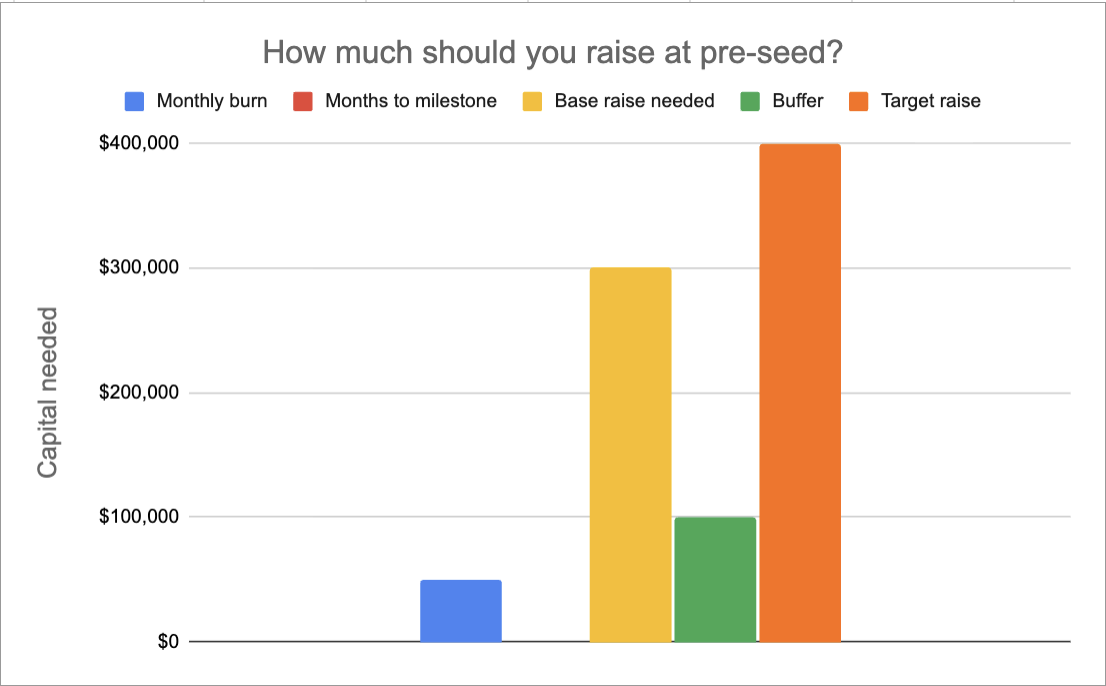
Let’s say you need 6 months to build the MVP and you estimate your monthly burn to be $50K. You may need $300K, plus a buffer of about $100K. It’s better to slightly overraise than underraise, so you are not stressed about cash if things go a bit unplanned.
The raise should be tied to a clear reason. Investors want to know what you’ll spend the funds on and how much you’ll need to spend to get to the next round.
Example:
Monthly estimated burn: $50K
Time to reach milestone: 6 months
Base raise needed: $50K × 6 months = $300K
Buffer: $100K
Target raise: $400K
 Seed investors


